Key Factors Driving Your PCB Board Cost
Understand what drives your PCB price. Key factors include board size, layer count, material type, and order quantity. Use a pcb board cost estimator for a quick quote.

The final PCB cost results from its physical attributes, design complexity, and manufacturing logistics. Several key factors determine this total cost. The most significant are the PCB size, layer count, material type, and order quantity. The pcb manufacturing process has many variables affecting the final price.
Note: Understanding each factor helps engineers optimize their design. This knowledge clarifies manufacturing quotes. A pcb board cost estimator can also help plan the material and manufacturing budget, leading to a lower final cost for the PCB.
- PCB size, number of layers, and material type are big factors in how much a board costs.
- Complex designs, like very thin lines or special holes, make PCBs more expensive to make.
- Ordering many PCBs at once lowers the cost for each board.
- Choosing standard materials and finishes, like FR-4 and HASL, helps keep costs down.
- Using a PCB cost estimator helps plan your budget before you start making boards.
The physical characteristics of a printed circuit board are the primary drivers of its base price. These attributes directly influence material costs and manufacturing processes. Understanding them is key to managing the overall pcb cost.
A larger pcb requires more raw materials, which directly increases material costs. The size also determines how many boards fit onto a standard manufacturing panel. Fewer boards per panel lead to a higher per-unit cost. For example, increasing a pcb from a standard size to a larger format can raise the cost by 20% to 50%.
| PCB Type | Size | Cost Impact |
|---|---|---|
| Standard PCB | 100mm × 100mm | $5 – $20 per board |
| Larger PCBs | 200mm × 300mm or more | Costs rise by 20% – 50% |
Tip: Designers can optimize layouts to fit more units on a standard manufacturing panel, such as the common 18” x 24” size. This practice, known as panelization, improves material utilization and reduces waste, lowering material costs.
Each additional layer in a pcb adds complexity to the manufacturing process. Moving from a 2-layer to a 4-layer design can increase the cost by 50% to 200%. This jump is due to the extra lamination and drilling steps required. While a 6-layer pcb offers a good balance for many complex designs, an 8-layer board involves even more intricate manufacturing and testing, further elevating material costs.
The choice of substrate material significantly affects the final cost. Standard FR-4 is the most common and affordable material. However, specialized applications demand advanced materials with higher material costs. The material selection process is critical for balancing performance and budget.
| Material | Price per Square Inch |
|---|---|
| Standard FR-4 | $0.50 – $1.50 |
| Rogers Materials | $5 – $15+ |
High-frequency applications like 5G and satellite systems often require PTFE (Teflon) or Rogers materials for their superior electrical properties. Polyimide is another premium material justified in designs needing high thermal durability. These advanced materials have higher material costs but are necessary for performance in demanding environments. The manufacturing of these materials is also more complex.
The standard pcb thickness is 1.6mm, which is the most economical option. Choosing a non-standard thickness, such as 0.8mm or 2.4mm, increases material costs. Thinner boards are fragile and harder to handle during manufacturing, while thicker boards require more material and longer drilling times. This deviation from the standard adds to the manufacturing cost.
Copper thickness, or weight, also influences cost. The standard is 1 ounce (oz) copper. Increasing the thickness to 2 oz can raise material costs by 10-20% because it uses more raw material. Heavy copper (3 oz or more) is reserved for high-current applications like EV charging stations. The specialized manufacturing needed for heavy copper further adds to the total pcb cost.

Beyond the basic material, the intricacy of a pcb design directly influences the final price. Greater circuit complexity requires more advanced manufacturing processes and tighter controls. These factors can significantly increase the overall pcb cost. A careful design balances performance needs with manufacturing realities.
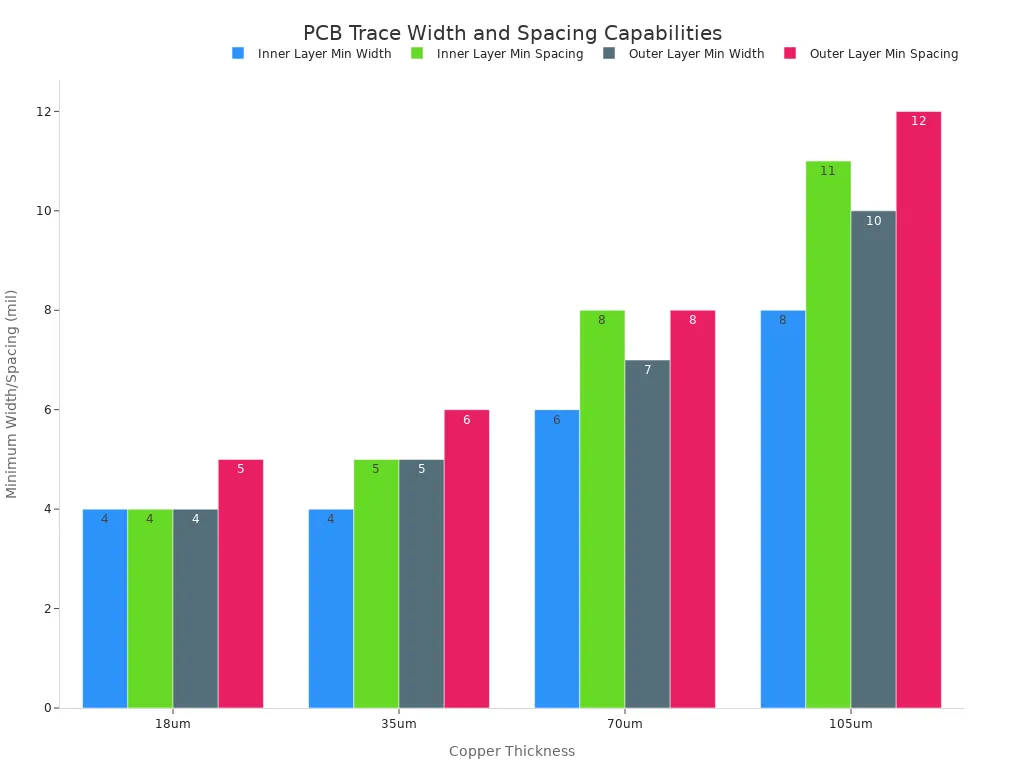
The distance between copper features is a major cost driver. Most manufacturers handle a standard trace width and spacing of 6 mils (6/6 mil) with ease. This standard design has a high manufacturing yield and low cost. However, pushing a design to finer lines, such as 3/3 mil for high-density routing, requires more expensive equipment and precision etching. This advanced manufacturing process lowers the yield. A lower yield forces the manufacturing facility to produce more panels to get enough good boards, passing that cost to the customer.
The required trace width also depends on the copper thickness. Thicker copper needs wider spacing.

Vias connect different layers of a pcb. Standard through-hole vias are the most economical. More complex vias, like blind or buried vias, add significant cost. Blind vias connect an outer layer to an inner layer, while buried vias connect two inner layers. Both require additional manufacturing steps like sequential lamination and drilling. This extra manufacturing work increases the price. Microvias, used in High-Density Interconnect (HDI) design, are even smaller and require specialized laser drilling, further raising the manufacturing cost.
| Via Type | Cost (Relative to Through-Holes) |
|---|---|
| Blind Vias | 15–20% more |
| Buried Vias | 25–30% more |
The surface finish protects the exposed copper and provides a solderable surface. The choice of material for the finish impacts the final cost. Hot Air Solder Leveling (HASL) is the most common and affordable option. Electroless Nickel Immersion Gold (ENIG) offers a flatter surface and longer shelf life but is more expensive. The ENIG manufacturing process is more complex and uses a precious material, gold. This increases both the material and manufacturing cost.
| Surface Finish | Cost per Square Inch |
|---|---|
| HASL | $0.10 to $0.30 |
| ENIG | $0.30 to $0.60 |
Choosing the right finish involves a trade-off between the pcb performance requirements and the budget for the manufacturing and material.

The final price of a PCB is also shaped by manufacturing schedules and logistical details. These elements control how and when a board is produced and delivered. Understanding them is key to managing the total project cost.
Order volume directly impacts the per-unit cost. Every PCB manufacturing run has initial setup fees for tooling and machine programming. For small prototype orders, these fees make up a large portion of the total cost. Larger production runs spread these setup costs over many boards. This principle, known as economy of scale, significantly lowers the price for each individual PCB. A larger order quantity makes the entire manufacturing process more efficient.
The required delivery speed is a major cost driver. Standard manufacturing takes around 5 to 10 days. Customers needing a faster turnaround time must pay a premium.
Note: A rush service that delivers a PCB in one or two days can increase the manufacturing cost by a multiplier of 2.0x to 3.0x. This higher cost covers the disruption to the standard production flow.
External factors also affect delivery. International holidays can increase air freight rates, while port congestion can cause significant delays and raise logistics costs. This makes planning for the pcb assembly schedule crucial.
Engineers can use an online pcb board cost estimator for quick budget planning. These tools provide instant quotes based on key project specifications. To get a reliable estimate, users must provide accurate data. A good pcb board cost estimator will ask for the following details:
- Board dimensions and quantity
- Number of layers
- Material type (FR-4, Rogers, etc.)
- Copper thickness and surface finish
- Number and type of drill holes
This tool helps teams balance design features against their budget before committing to fabrication. A pcb board cost estimator is essential for modern pcb manufacturing.
Standard manufacturing processes have accepted tolerances. Requesting tighter specifications than the standard increases the manufacturing cost. This is because special tolerances require more advanced equipment, slower production speeds, and more rigorous testing, which can lower manufacturing yields. Examples of special tolerances that raise the pcb cost include:
| Tolerance Type | Standard | Tighter (Higher Cost) |
|---|---|---|
| Drill Hole | ±0.003” | ±0.002” or less |
| Routing | ±0.005” | Smaller radii (<0.040″) |
| Impedance Control | ±10% | ±5% |
For instance, tightening impedance control from a standard ±10% to a stricter ±5% can add several dollars to the cost of each PCB. This precision manufacturing ensures performance but comes at a price.
A PCB’s final cost depends on its core attributes, design complexity, and manufacturing logistics. Engineers can manage this cost by making smart choices. A pcb board cost estimator helps in early planning.
Actionable Tips for Cost Reduction:
- Consult with your manufacturing partner early. Optimizing the design and material selection can reduce manufacturing and materials costs by 15-20%.
- Stick to standard specifications like 1.6mm thickness, green solder mask, and HASL finish.
- Optimize the PCB design for panelization and order in larger batches when possible.
A smart design process balances performance needs with a keen awareness of these manufacturing and material factors. This approach ensures an efficient and cost-effective PCB.
Prototype orders have a high per-unit cost. Manufacturing setup fees are the main reason. These initial tooling and programming costs are spread across a very small number of boards. This makes each individual board seem expensive compared to a large production run.
Standard FR-4 is the most affordable and common PCB material. It offers a good balance of electrical performance and durability for many applications. Specialized materials like Rogers or polyimide have higher material costs due to their advanced properties for specific, demanding environments.
Engineers use an online PCB board cost estimator for fast pricing. These tools ask for key details like board size, layer count, and material. The estimator then provides an instant quote. This helps teams plan their budget before starting production.
Yes, color can impact the final PCB cost. Green is the industry standard and the most economical choice. Manufacturers produce it in large volumes. Other colors like red, blue, or black often require separate production runs, which can slightly increase the manufacturing cost.